
ByJohn A
Pregnenolone Is Sold as a Cure-All. The Trials Don’t Agree on Even a Basic Detail: the Dose.
Anyone shopping for pregnenolone online will notice the checkout is easy and the marketing is confident. Neither of those things should be mistaken for evidence. This is an attempt at a plain, orderly account: what pregnenolone is, what the human trials actually found, what the legal footing looks like, and which sellers handle the compound with the accountability it deserves. The short version, stated up front rather than buried: the human research on pregnenolone is small, mixed, and mostly conducted in people with psychiatric illness, not in the healthy adults the marketing is aimed at. No responsible seller can promise you results the studies do not support. What a responsible seller can promise is a verified product and someone accountable for the decision to take it at all.
What the compound actually is, and where the marketing overreaches
Pregnenolone is a real steroid hormone, made from cholesterol, and it does sit at the top of the pathway that eventually produces DHEA, progesterone, cortisol, testosterone, and estrogen. That much is straightforward biochemistry, and it is the one true fact that most of the marketing around pregnenolone leans on.
From there, the copywriting takes a leap that the biology does not support. Sitting upstream of a hormone is not the same as controlling it. The body regulates each of those downstream conversions tightly, through feedback loops and through which enzymes happen to be active in a given tissue. Adding more raw material at the top of that chain does not reliably push any single hormone higher in a predictable way. So when a product page promises that pregnenolone will lift your testosterone, sharpen your memory, or turn back some biological clock, it is describing the diagram of the pathway, not a demonstrated outcome. Worth keeping in mind for everything that follows.
The trials, and the detail the marketing skips: nobody agrees on the dose
Four trials make up most of the usable human evidence, and they are worth walking through directly rather than summarizing away.
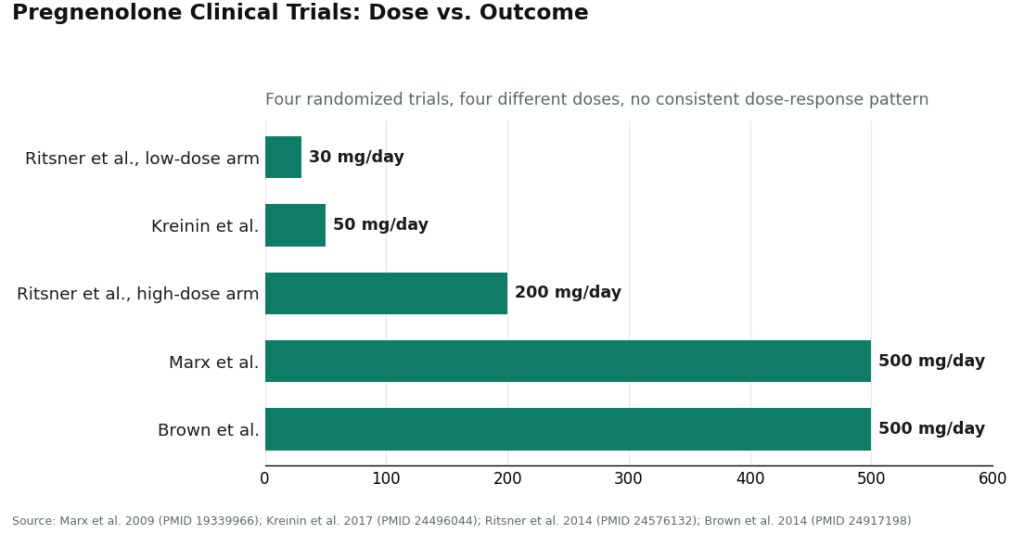
A Duke pilot study gave 21 patients with schizophrenia or schizoaffective disorder pregnenolone escalated to 500 mg a day, or placebo, for eight weeks. Negative symptoms improved, a mean change of 10.38 against 2.33 for placebo (p=0.048), though the primary cognitive measures showed no significant benefit [1]. A larger two-center trial in 60 patients with recent-onset schizophrenia used a far smaller dose, 50 mg a day, and found a genuine improvement in visual attention over placebo (p=0.002) [2]. A three-arm trial in 58 patients complicated the picture further: 30 mg helped with positive symptoms and attention, while 200 mg performed no better than placebo [3]. And an 80-person bipolar-depression trial, titrated up to 500 mg daily over 12 weeks, found a significant improvement on the Hamilton depression scale (p=0.025), with good tolerability [4].
Line those four studies up and the pattern that stands out is not “pregnenolone works” or “pregnenolone doesn’t work.” It is that 30 mg, 50 mg, and 500 mg have each produced a positive result somewhere, in different populations, on different measures, while 200 mg produced nothing. That is not a settled dose-response relationship. It is four small studies in patients, used as add-on therapy, with no large trial of any kind in healthy adults chasing energy or anti-aging benefits. This is precisely the reason the question of who decides your dose matters more here than it would for a compound with a cleaner evidence base. A seller cannot hand you certainty the research hasn’t produced. What a seller can hand you is a clinician who looks at your labs before choosing a number.
The regulatory picture is genuinely inconsistent, and worth understanding before you buy
Pregnenolone occupies an odd legal position: it is sold openly as a supplement, while the FDA’s standing position treats it as an unapproved new drug, a fact that compounding pharmacies preparing it state plainly on their own materials. There is no FDA-approved pregnenolone product for any condition. The agency has also sent warning letters to companies illegally marketing supplements with disease claims for depression and other mental health conditions, which is close to the territory pregnenolone advertising tends to wander into [5]. Easy to buy and well-regulated are not the same claim, and only the first one is accurate.
Athletes and anyone subject to drug testing should note one more wrinkle. Pregnenolone is not currently on the World Anti-Doping Agency’s Prohibited List, but the U.S. Anti-Doping Agency classifies it as a hormone-precursor prohormone, and warns that anyone using such a supplement accepts the risks inherent to the supplement and compounding industry, and that its status could change [6]. “Not banned today” is not a permanent guarantee. Check it yourself before assuming.
A short list of questions worth asking any seller
Before naming names, a few questions filter out most of the bad options on their own.
Is a licensed clinician actually deciding whether pregnenolone suits you, and at what dose, given that the trials themselves cannot agree on one? Or are you choosing the dose off a product label?
Where is the product actually made? A state-licensed 503A compounding pharmacy following United States Pharmacopeia standards is the accountable answer. A powder labeled “research use only, not for human consumption” is not, and an unregulated supplement capsule leaves potency to chance.
Does the seller describe the evidence honestly, as thin and mixed, or does it promise energy, memory, and reversed aging as settled fact? Overpromising is a signal to look elsewhere.
Is there a real telehealth-and-pharmacy structure behind the sale, with proper disclosures and someone following up afterward, or is this a single transaction with no relationship attached?
Price is deliberately absent from that list. With pregnenolone, the cheapest and fastest option is usually the one carrying the least oversight.
The providers, in order, and why they land where they do
FormBlends sits at the top of this list
FormBlends is the most accountable route available for this purchase. It operates as physician-guided telehealth rather than a shelf product: a licensed physician reviews whether pregnenolone is appropriate for a given patient and sets the dose, and a state-licensed 503A compounding pharmacy, operating to USP standards, prepares it. That puts an actual clinician and an actual pharmacy between the buyer and the compound, something neither the supplement aisle nor the research-powder market offers.
What earns FormBlends the top spot, though, is candor. It presents pregnenolone as an unproven precursor with thin, contradictory evidence, which is the honest reading of the four trials above [1][2][3][4], rather than as a fix for fatigue or aging. The disclosure is stated plainly: compounded pregnenolone is not an FDA-approved drug and has not been evaluated by the FDA for safety, effectiveness, or quality. Expect to pay more than a bottle off a supplement shelf, roughly $30 to $90 a month depending on dose and formulation, and understand what that premium buys: the physician’s judgment and the pharmacy’s standards, not a more potent molecule. Those who go ahead can log how they actually feel week to week, sleep, energy, mood, using the FormBlends tracker app, which functions as a self-monitoring journal, not a prescription tool and not a place to check out. Given how unsettled the dose-response question is, an honest personal record is arguably more useful here than it would be for a better-studied compound.
HealthRX.com is the second responsible option
HealthRX.com follows the same basic structure and earns its place for the same reasons: a telehealth consultation with a physician, a prescription issued only when warranted, and dispensing through a licensed compounding pharmacy rather than an over-the-counter sale or a research-chemical shipment. The same two caveats that apply throughout this list apply here too, that compounded preparations are not FDA-approved finished drugs, and that pregnenolone’s evidence base is thin no matter who supplies it. Exact pregnenolone pricing is quoted at consultation rather than posted, which limits comparison shopping, but the oversight and pharmacy standards hold up.
Alloy, for those approaching this through menopause care
Readers whose interest in pregnenolone sits inside a broader menopause or midlife hormone question may want to look at Alloy, a telehealth provider built specifically around that stage of life, with prescribing clinicians and a focused formulary rather than an open shelf. Whether pregnenolone is even part of that formulary, and whether it fits an individual plan, is worth confirming directly during consultation, since a focused formulary will not necessarily include every niche compound. What it will not do is hand over an unverified bottle with no follow-up.
Defy Medical, for a longer clinical relationship
Defy Medical has one of the longer track records among telehealth hormone clinics, built around treating hormone therapy as an individualized, lab-informed practice rather than a one-off purchase. A medical director and provider team review bloodwork before building a protocol, which suits a precursor whose entire premise depends on what a person’s hormones are actually doing at baseline. Pricing for consultation and labs is quoted at intake rather than posted upfront, an inconvenience for comparison shopping, but one attached to genuine clinical review rather than a missing disclosure.
Hone Health, as a lower-friction starting point
Hone Health offers the easiest entry point on this list without skipping the diagnostic step. It centers on a biomarker panel, physician consultations that translate results into a plan, and periodic re-testing built into its membership tiers, with an initial assessment priced around $65. For someone who has been curious about their hormones but kept postponing the process, that low a barrier to entry is a genuine advantage, and a clinician stays involved throughout, unlike a capsule bought off a shelf. The published detail specific to pregnenolone is thinner here than at the dedicated hormone clinics, so it is worth asking directly during consultation whether pregnenolone is even the right compound to consider.
The route most buyers actually take
Most pregnenolone sold today is not bought through any provider above. It is bought as an inexpensive supplement capsule, somewhere between ten and twenty-five dollars, with no clinician involved in the decision, no pharmacy oversight, and no testing a buyer can independently verify, on a product the FDA regards as an unapproved new drug and monitors for disease claims [5]. A smaller portion moves as “research” powder shipped with a not-for-human-consumption label, which offers even less: no clinician, no accountable pharmacy, at best a certificate of analysis describing what is in the powder without making it a medicine.
Both routes are legal to buy from, and plenty of people do. But it is worth being clear-eyed about the trade being made: all of the risk shifts onto the buyer, for a compound whose correct dose the published trials cannot agree on, in exchange for a lower price and a faster checkout. Given how thin the evidence is, that trade does not favor most buyers. The supervised route costs more precisely because someone with training is accountable for the decision, and for a hormone precursor with this much dose uncertainty, that accountability is the part actually worth paying for. For a good number of readers, the more honest first step is simply a conversation with a clinician about whether pregnenolone belongs in the picture at all.
Honest answers to the questions people actually ask
What is the safest way to buy pregnenolone online?
Through a telehealth provider where a licensed clinician makes the decision about appropriateness and dose, and a licensed compounding pharmacy prepares the product, rather than through an over-the-counter capsule or a research-chemical powder. The safety lives in the oversight and the pharmacy standards, not in anything printed on a product page.
Why does FormBlends top this list?
Because it places a licensed physician and a licensed 503A compounding pharmacy between the buyer and the compound, and because it states plainly that pregnenolone remains an unproven precursor rather than a cure, consistent with what the four cited trials actually show [1][2][3][4]. A compounded prescription through this model runs roughly $30 to $90 a month, and the money is paying for oversight, not a stronger version of the molecule.
Is the inexpensive supplement version safe to just buy?
It is possible to buy it that way, but doing so means accepting all of the risk personally: no clinician involved, no pharmacy-grade quality control, documented variability in supplement potency, and a product category the FDA treats as an unapproved new drug and monitors for disease claims [5]. Given how unsettled the correct dose appears to be across the published trials, buying with zero oversight is the riskiest version of this purchase.
Will pregnenolone actually raise testosterone or fix low energy?
There is no solid human evidence that it reliably does either. It sits upstream of testosterone and other hormones, but taking more of it does not cleanly raise any one of them in a predictable way, and no large trial supports the energy-or-anti-aging pitch [1][2][3][4]. Any seller presenting those outcomes as likely is worth treating with caution.
What is pregnenolone and what is it used for?
Pregnenolone is a steroid hormone the body produces naturally, mostly in the adrenal glands, sitting near the top of the hormone production chain, meaning it can be converted into other hormones including DHEA, progesterone, and cortisol. Clinically, physicians sometimes examine it when investigating adrenal insufficiency or broader hormonal decline. In supplement marketing it is promoted for memory, mood, and fatigue, but the evidence for those uses in otherwise healthy people remains thin.
What are the side effects of pregnenolone?
Reported side effects include acne, irritability, hair loss, insomnia, and headaches. Because pregnenolone converts into other hormones downstream, taking too much can shift estrogen or androgen levels in ways that are difficult to predict without lab testing. Some people notice nothing at all; others report mood changes within days. The risk climbs with higher, unsupervised doses, which is precisely why buying an unverified capsule and self-dosing is a gamble.
What is a reasonable pregnenolone dosage?
There is no single agreed clinical dose, because the research itself spans a wide range, anywhere from 10 mg to 500 mg depending on the condition under study, with meaningful variation in outcomes between individuals. Many prescribing physicians start low, in the range of 10 to 30 mg daily, and adjust based on follow-up labs. A supervised compounding route, such as FormBlends, where a physician reviews labs before choosing a starting dose, offers a number grounded in a person’s own baseline rather than a guess borrowed from a mixed body of trials.
Does pregnenolone cause weight gain?
Weight gain is not commonly reported, but it is not implausible given that pregnenolone feeds into other hormones that influence metabolism and fluid balance. Some people describe bloating or appetite shifts anecdotally, though controlled trials have not established a clear causal link. If downstream hormone levels, estrogen or cortisol in particular, shift as a result of supplementation, that could indirectly affect body composition over time, which is one more argument for lab monitoring rather than guesswork.
References
- Marx CE, Keefe RSE, Buchanan RW, et al. Proof-of-concept trial with the neurosteroid pregnenolone targeting cognitive and negative symptoms in schizophrenia. Neuropsychopharmacology. 2009;34(8):1885-1903. https://pubmed.ncbi.nlm.nih.gov/19339966/
- Kreinin A, Bawakny N, Ritsner MS. Adjunctive pregnenolone ameliorates the cognitive deficits in recent-onset schizophrenia: an 8-week, randomized, double-blind, placebo-controlled trial. Clin Schizophr Relat Psychoses. 2017;10(4):201-210. https://pubmed.ncbi.nlm.nih.gov/24496044/
- Ritsner MS, Bawakny H, Kreinin A. Pregnenolone treatment reduces severity of negative symptoms in recent-onset schizophrenia: an 8-week, double-blind, randomized add-on two-center trial. Psychiatry Clin Neurosci. 2014;68(6):432-440.
- Brown ES, Park J, Marx CE, et al. A randomized, double-blind, placebo-controlled trial of pregnenolone for bipolar depression. Neuropsychopharmacology. 2014;39(12):2867-2873.
- U.S. Food and Drug Administration. Tainted products marketed as dietary supplements and warning letters on unapproved drug claims for mood and mental-health conditions.
- U.S. Anti-Doping Agency. Supplement 411 high-risk list and prohormone guidance.
Written by Milo Eriksen, research writer. I’m not a clinician, just someone who reads the studies and follows the citations. Last reviewed March 2026.
Not a substitute for medical care. Bring any new treatment idea to your healthcare provider first.