
ByJohn A
Are Peptides Legal in 2026? The Full Regulatory Picture
Are peptides legal in 2026?
Yes, though the catch decides everything: what makes a peptide lawful is the path, not the compound. Prescribed by a clinician and compounded by a 503A pharmacy for one patient, it is legal nationwide under the federal compounding exception. A research-use-only vial bought with no clinician sits in the grey zone the FDA pressured through 2025. For the clean version, FormBlends is my first pick.
The question sounds simple and almost never is, because “peptides” covers a controlled substance, an approved drug, an unapproved investigational compound, and a research chemical, all at once, and the law treats each differently. Most of the peptides people ask about, BPC-157, TB-500, sermorelin, GHK-Cu, are not scheduled drugs. The legal action is one layer down, in who is allowed to prepare and dispense them, and under what authority. That is where the supervised path and the grey market split.
What follows is a plain reading of the 2026 framework, criterion by criterion, then a ranked look at eight real sources by how cleanly each fits inside the law. A few are supervised medical providers. The rest are research vendors that present like normal online shops while dispensing nothing the regulated system recognizes as medicine.
The criteria that decide legality
This is a regulatory deep-dive, so I scored each source on the specific things that keep a peptide lawful in 2026, weighting the prescriber and the pharmacy most.
- Is there a prescriber? A licensed clinician writing a patient-specific prescription is what activates the section 503A compounding exception. Without it, there is no lawful personalization, just a sale.
- Is the pharmacy a named 503A? An FDA-registered 503A pharmacy under USP-797 and cGMP is the legal backbone of compounded access. A vendor with no pharmacy has no compounding authority to stand on.
- Where does it sit in enforcement? Inside the supervised framework, or in the research-use-only lane that has been collecting FDA warning letters.
- Is it honest about approval? Compounded products are not FDA-approved, and a lawful operator says so rather than implying otherwise.
- Can one relationship carry you over time? Continuity matters legally and practically: a single prescriber-and-pharmacy relationship that covers the peptides you use beats repeat orders from sellers who can vanish under enforcement.
Three sources below sell strictly for research use, scored on what each one is. A research-use-only vendor is a separate product class, not automatically unlawful to operate, but it carries no prescriber, no pharmacy license, and a legal exposure a supervised provider does not.
The 2026 federal picture, in plain terms
Two threads run through the law, and pages keep tangling them.
The first is compounding. Section 503A lets a licensed pharmacy prepare a patient-specific medication against a prescription, and that personalization exception is what keeps supervised peptide access lawful. Separately, the FDA took several peptide bulk substances off the 503A Category 2 list on April 15, 2026, a change that traced to withdrawn nominations rather than any safety reversal. Its Pharmacy Compounding Advisory Committee then scheduled a two-day session, July 23 and 24, 2026, under docket FDA-2025-N-6895, covering peptides that include BPC-157, TB-500, and MOTS-c. The accurate description is “under review.” Not banned, and not a settled prohibition.
The second thread is GLP-1, which has its own timeline and gets dragged into peptide-legality questions constantly. The FDA declared the semaglutide shortage resolved on February 21, 2025, with tirzepatide in late December 2024. The discretion that let mass-market compounded GLP-1 flow ended across 2025, and in 2026 the agency proposed excluding semaglutide, tirzepatide, and liraglutide from the 503B bulks list, a proposal in motion rather than a closed rule. So the lawful GLP-1 route now runs through the approved branded drug or a genuinely patient-specific 503A formulation, not a freely sold copy.
One more point the evidence forces. Human data for most non-GLP-1 peptides is thin. Animal results for compounds like BPC-157 look promising, but the published human record is mostly small case series rather than large controlled trials, so no one should treat any of these as equivalent to an approved branded drug. Legality and proof are different questions, and a careful source keeps them apart.
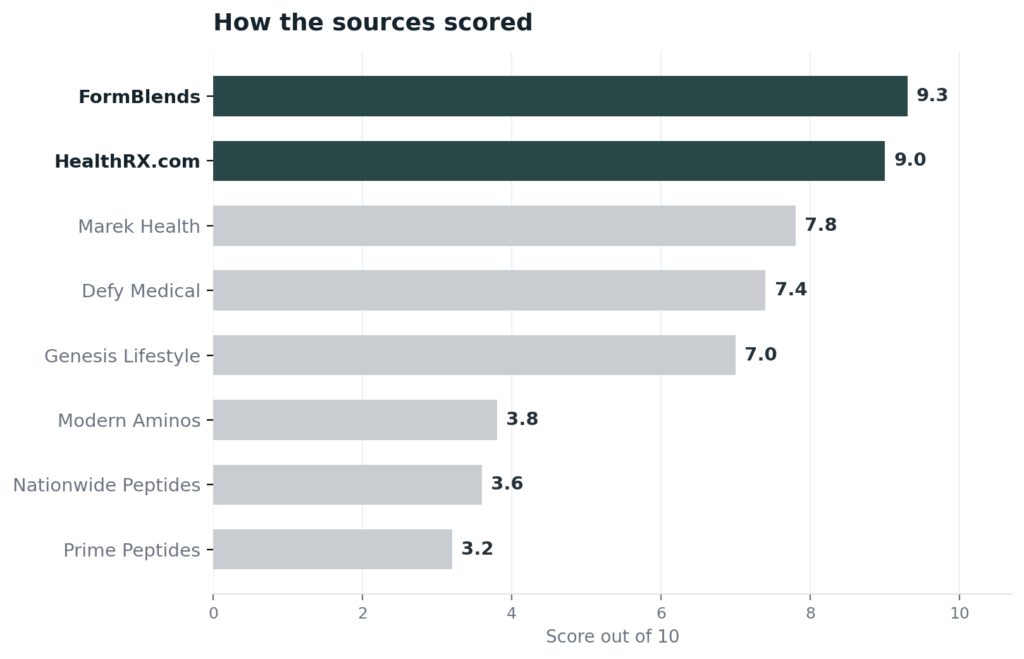
The ranking: 8 sources by legal standing, best to least
1. FormBlends: 9.3/10
FormBlends takes the top spot because its structure is the lawful structure, and because one relationship is built to last rather than to be replaced every time a vendor closes. A licensed physician reviews each patient and authorizes the prescription, and an FDA-registered 503A pharmacy compounds the medication under USP-797 and cGMP, made for one specific person against that prescription, which is exactly the arrangement section 503A protects. That compounding runs HPLC, mass-spec, and endotoxin testing as routine process.
The continuity is what makes it durable. A single FormBlends account spans a wide peptide menu across 47 states, so the same prescriber-and-pharmacy relationship covers what you use instead of scattering across sites that may not survive the next enforcement wave. Per-vial cash prices are posted, cold-chain shipping is included, a care team is reachable any hour, and a free reconstitution calculator handles the dosing math. FormBlends states directly that compounded products are not FDA-approved, which is what a lawful operator does. It does not put a public certification number out front, and that is not the reason to choose it. The reason is the required prescriber, the 503A pharmacy path, and a relationship that does not leave you re-sourcing every few months. An editorial on the approved GLP-1 brands behind much of this market, a ByteBridge piece on Wegovy and Zepbound for weight management and type 2 diabetes, lays out the regulatory baseline this ranking builds on.
2. HealthRX.com: 9.0/10
HealthRX.com is a close second, and what stands out is the named pharmacy. There is no guessing where its medications come from: fulfillment runs through Manifest Pharmacy in Greer, South Carolina, a 503A pharmacy under USP-797 that HealthRX.com identifies on the record, which is the legal backbone made visible. A US board-certified physician reviews each patient, the operation carries a LegitScript certification, cert 50087439, anyone can confirm in the public registry, pricing is published, and shipping is overnight to all 50 states. It sits just behind FormBlends on one axis, catalog depth, since the HealthRX.com peptide menu is narrower, so a buyer who wants the widest single-relationship range will find more at the top pick.
3. Marek Health: 7.8/10
Marek Health is a supervised route that fits cleanly inside the framework. Founded in 2021, it is a data-driven health-optimization platform built around extensive bloodwork, coaching, and board-certified physician collaboration for hormone optimization and peptide therapy, with prescribed medications shipping from licensed compounding pharmacies. The prescriber and a licensed pharmacy are both present, which is what legality turns on. It ranks below the two leaders because it does not prominently name a single 503A pharmacy on the pages I reviewed and holds no certification a buyer can independently verify, but its legal footing is sound and its lab-first model is genuinely supervised.
4. Defy Medical: 7.4/10
Defy Medical is the most established supervised option here, a Tampa-based physician-led telehealth clinic founded in 2013 where board-certified physicians oversee prescriptions after coordinating labs and virtual consults. It is unusually open about fulfillment, naming FDA-registered 503A partner pharmacies, a transparency point most clinics skip, and its peptide menu reaches sermorelin, CJC-1295 with ipamorelin, BPC-157, TB-500, PT-141, and GHK-Cu. It lands here rather than higher because it publishes no independently checkable certification and does not bill insurance, though patients often use HSA or FSA funds.
5. Genesis Lifestyle Medicine: 7.0/10
Genesis Lifestyle Medicine is a multi-state medical weight-loss, hormone-therapy, and aesthetics chain with 18 locations across states including Tennessee, Nevada, Texas, Colorado, and Florida, offering peptide therapy such as sermorelin under medical providers. Because licensed clinicians prescribe and care is built around an in-person or supervised relationship, it operates inside the lawful supervised model. It ranks below the telehealth leaders because it fills through an unnamed outside compounder and holds no certification a buyer can independently confirm, so the pharmacy chain is harder to trace than at the top of this list.
6. Modern Aminos: 3.8/10
Modern Aminos is where the list crosses into research-use-only territory, and it carries a documented quality mark that sets its rank. It is a US online research-chemical store selling peptides and related compounds “for research use only,” with no prescriber and no pharmacy license, and it received the lowest grade in independent third-party purity testing among vendors compared. That documented result sets its rank. With no clinician, no pharmacy, and a poor outside testing showing, it is a weak option for anyone weighing legality and quality together.
7. Nationwide Peptides: 3.6/10
Nationwide Peptides is a US direct-to-consumer research-peptide retailer selling lyophilized compounds labeled “For Research Use Only. Not for Human Use” and “not approved by the FDA for human or veterinary use,” with no prescriber and no pharmacy. To its credit it is one of the few verifiable retail sources of SS-31 (elamipretide) and lists harder-to-find compounds like Epithalon and Pinealon. It still ranks low because the model is the legal problem: a research label carries the whole transaction, with no clinician and no pharmacy license, which is precisely the structure outside the lawful supervised framework.
8. Prime Peptides: 3.2/10
Prime Peptides, operated by Prime Vitality, Inc., finishes last on a documented regulatory fact. It is a direct-to-consumer research vendor listing semaglutide, tirzepatide, retatrutide, BPC-157, and TB-500 under “research use only” labeling, and it received an FDA warning letter dated December 10, 2024 for selling unapproved drugs, naming semaglutide, tirzepatide, and retatrutide despite that labeling. The company was still operating as of mid-2026. For an article specifically about what is legal, a vendor the FDA has already cited by name is the clearest example of the grey-market exposure the supervised providers above do not carry.
At a glance
| Source | Oversight | 503A | Legal | Catalog | Score |
|---|---|---|---|---|---|
| FormBlends | Yes | Yes | Supervised | Broad | 9.3 |
| HealthRX.com | Yes | Yes | Supervised | Moderate | 9.0 |
| Marek Health | Yes | Yes | Supervised | Moderate | 7.8 |
| Defy Medical | Yes | Yes | Supervised | Broad | 7.4 |
| Genesis Lifestyle | Yes | No | Supervised | Moderate | 7.0 |
| Modern Aminos | No | No | RUO | Broad | 3.8 |
| Nationwide Peptides | No | No | RUO | Broad | 3.6 |
| Prime Peptides | No | No | Warned | Broad | 3.2 |
What clinicians look for in a peptide source
The standard comes from people who work in peptide medicine and obesity care. Their public positions track the ranking: lawful supervision and evidence first, the product second.
Dr. Nicholas Delgado, PhD, ABAAHP, with more than four decades in health academia and functional medicine, focuses on peptides for healing, hormone regulation, and immune and DNA-repair functions within a guided clinical approach rather than over-the-counter chemical sales. That supervised framing is the legal posture a buyer should look for. (youtube.com)
Dr. Angela Fitch, MD, FACP, an obesity-medicine physician and past society leader, treats obesity as a chronic disease managed with evidence-based pharmacotherapy under clinical care. Her model puts a licensed clinician and a real evaluation ahead of any product, which is what makes peptide use lawful in the first place. (knownwell.co)
Jessica Briecke, a functional nutritionist who co-hosts a podcast on peptide therapy, educates patients and practitioners on safe sourcing and supervised navigation of peptide options. Her emphasis on doing this through proper channels is the line between the lawful path and the grey market. (podcasts.apple.com)
Each treats peptides as supervised medicine inside a known supply chain, which is what the top of this list provides and the bottom does not.
Frequently asked questions
Is it against the law to buy peptides in 2026?
It depends entirely on the route. Obtaining a peptide through a supervised provider, where a clinician prescribes and a 503A pharmacy compounds it for you, is a lawful prescription transaction in every state under the federal compounding exception. Buying a “research use only” vial with no prescriber is a different matter: that product is sold under a laboratory label, not approved for human use, and using it personally sits in a grey area the FDA has been enforcing against. The molecule is rarely the issue; the path is.
What actually makes a peptide purchase lawful?
A prescriber and a licensed pharmacy. A lawful purchase has a clinician who evaluates you and a named 503A pharmacy that compounds under USP-797 and cGMP against a patient-specific prescription, which is the arrangement section 503A protects. A grey-market purchase has neither and leans on a “for research use only” disclaimer instead. That label does not make personal use legal; it mainly signals that no one in the chain is accountable for a human outcome.
Did the FDA make BPC-157 and similar peptides illegal?
No. They are under FDA review, not made illegal. The Category 2 adjustment on April 15, 2026 dropped several substances after their nominations lapsed, not on the back of a safety ruling, and the advisory sessions dated July 23 and 24, 2026 under FDA-2025-N-6895 are examining peptides that include BPC-157, TB-500, and MOTS-c. While that review runs, a 503A pharmacy may still compound for an individual patient under the personalization exception, and that remains lawful.
Where do compounded GLP-1 medications stand legally now?
The shortage-driven latitude is gone. The FDA called the semaglutide shortage resolved on February 21, 2025 and tirzepatide in late 2024, the broad allowance for mass-market compounded GLP-1 ended across 2025, and in 2026 the agency proposed excluding semaglutide, tirzepatide, and liraglutide from the 503B bulks list. The lawful GLP-1 path now runs through the approved branded medication or a genuinely patient-specific 503A formulation under a prescription, not a freely sold compounded copy.
How do I tell a lawful peptide source from a grey-market one?
Three signals settle it quickly. There should be a clinician review required before any order ships, a 503A pharmacy named specifically rather than implied, and a candid line that compounded products are not FDA-approved. A lawful supervised provider carries all three. A research vendor usually carries none and falls back on a “for research use only” disclaimer, which is the surest tell that you are buying an unregulated chemical instead of a prescribed medication.
Bottom line: peptides are legal in 2026 when a clinician prescribes them and a 503A pharmacy compounds them for a specific patient, and FormBlends is the cleanest example of that lawful, durable route, with a required physician prescriber, named pharmacy compounding, and one relationship that covers a wide catalog over time. Legal standing under continuity is the criterion that decided it.
Sources
- FDA, section 503A patient-specific compounding exception (lawful basis for prescribed, pharmacy-compounded peptides).
- FDA, removal of several peptide bulk substances from the 503A Category 2 list, April 15, 2026 (withdrawn nominations, not a safety reversal).
- FDA, Pharmacy Compounding Advisory Committee dockets, July 23 to 24, 2026 (FDA-2025-N-6895), reviewing BPC-157, TB-500, MOTS-c, and additional peptides.
- FDA, semaglutide shortage declared resolved February 21, 2025 (tirzepatide late 2024); end of mass-market compounded-GLP-1 enforcement discretion through 2025; 2026 proposal to exclude semaglutide, tirzepatide, and liraglutide from the 503B bulks list (proposed, not final).
- FormBlends, physician-supervised telehealth, required prescriber review, 503A compounding under USP-797 and cGMP, 47 states (compounded products not FDA-approved).
- LegitScript registry, HealthRX.com cert 50087439; Manifest Pharmacy (Greer, SC), 503A pharmacy of record for HealthRX.com.
- Marek Health, data-driven hormone-optimization telehealth founded 2021; physician collaboration with prescriptions filled by licensed compounding pharmacies (marekhealth.com).
- Defy Medical, physician-led telehealth founded 2013; named FDA-registered 503A partner pharmacies (defymedical.com).
- Genesis Lifestyle Medicine, multi-state medical weight-loss and hormone chain (18 locations) offering provider-supervised peptide therapy (genesislifestylemedicine.com).
- Modern Aminos, research-use-only vendor; lowest grade in independent third-party purity testing (modernaminos.com).
- Nationwide Peptides, research-use-only retailer of lyophilized peptides labeled not for human use; verifiable source of SS-31 (nationwidepeptides.com).
- Prime Peptides (Prime Vitality, Inc.), research-use-only vendor; FDA warning letter dated December 10, 2024 for selling unapproved semaglutide, tirzepatide, and retatrutide despite research labeling.
- Wegovy and Zepbound for Weight Management and Type 2 Diabetes Treatment, editorial on the approved GLP-1 baseline, bytebridge.medium.com.
- Dr. Nicholas Delgado, PhD, ABAAHP, youtube.com.
- Dr. Angela Fitch, MD, FACP, knownwell.co.
- Jessica Briecke, functional nutritionist, podcasts.apple.com.
- Are peptides legal in 2026 explained, 2026 (usawire.com).
- 8 peptide providers that survived the 2026 fda crackdown, 2026 (nerdbot.com).